
English 
Views: 0 Author: Site Editor Publish Time: 2026-09-22 Origin: Site


Engineers and product managers face a tough challenge when selecting a display for new hardware. You must balance unit cost, optical performance, and strict environmental constraints. If you choose the wrong liquid crystal technology, you risk poor readability, bloated power budgets, or unnecessary expenses. TN, HTN, STN, and FSTN represent a wide spectrum of monochrome liquid crystal technologies. Each type brings specific trade-offs regarding twist angle, contrast ratios, and multiplexing capabilities. We created this guide to provide a strictly objective, technical evaluation framework. It will help you quickly shortlist the correct screen for your specific commercial or industrial application. By understanding these core differences, you can confidently specify a display that meets both your user experience goals and hardware limitations. You will learn exactly how to match the right LCD technology to your required duty cycle and operating environment.
TN is the most cost-effective but is limited to basic, low-multiplexing applications with narrow viewing angles.
HTN bridges the gap between TN and STN, offering wider viewing angles at a lower cost than STN.
An STN LCD is the industry standard for high-information-density monochrome screens, supporting higher multiplex rates but introducing a natural color tint.
FSTN utilizes a compensation film to neutralize the STN tint, delivering true black-and-white contrast for premium readable interfaces.
Selecting the right monochrome LCD module depends heavily on your required duty cycle, operating temperature, and sunlight readability requirements.
Framing your display problem correctly is your critical first step. Avoid over-speccing, which wastes your hardware budget unnecessarily. Likewise, avoid under-speccing, which severely compromises the end-user experience. You must weigh four core evaluation dimensions before looking at manufacturer spec sheets.
You must decide between a direct drive and a multiplexed configuration early in the design phase. Direct drive displays assign one physical pin to every segment. They offer incredible contrast but require massive pin counts. Multiplexed displays share pins to reduce microcontroller overhead. High-density dot matrix displays require much higher twist angles to maintain contrast as multiplexing rates increase. A low multiplex rate works fine for basic digits, but complex graphics demand advanced fluid technologies.
Contrast ratio and viewing angle dictate how easily users can read your data. You must define the primary viewing direction. A 6 o'clock viewing angle works best when users look up at the screen, like a wall-mounted thermostat. A 12 o'clock viewing angle is ideal when users look down at a device resting on a desk. Furthermore, you must choose between positive and negative modes. Positive mode features dark text on a light background. Negative mode features light text on a dark background.
Operating and storage temperature extremes dictate your specific fluid choice. Liquid crystal fluids freeze or boil if pushed past their limits. Outdoor or industrial use cases demand robust temperature tolerances. Standard fluids handle 0°C to 50°C. Wide-temperature fluids extend from -20°C to 70°C, and ultra-wide fluids go even further. You must assess the actual environment where your product will live.
Battery-operated devices often prioritize simpler LCDs. They operate efficiently without power-hungry LED backlights. Reflective displays use ambient light, drawing mere microamps. Transmissive displays require continuous backlighting, heavily taxing your power budget. You must balance readability against battery life.
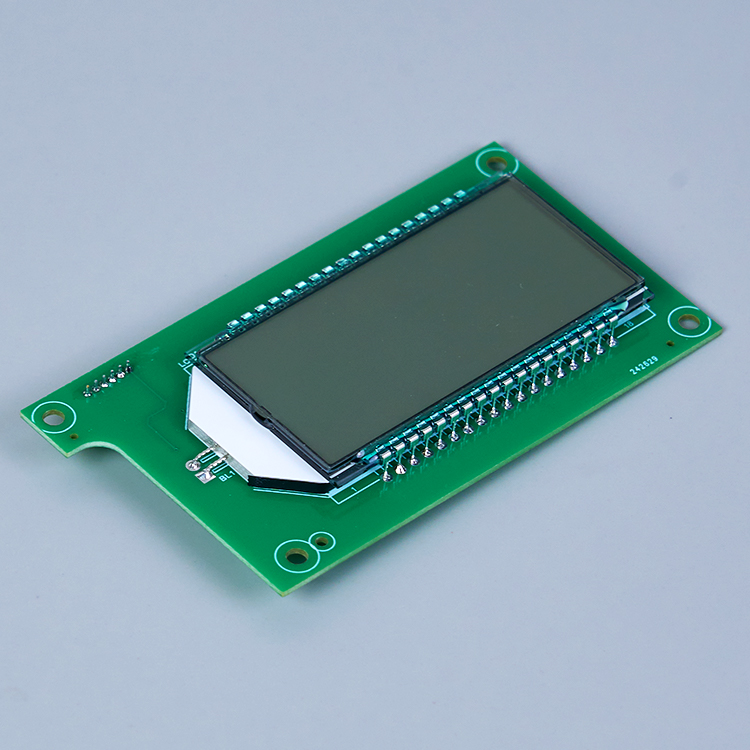
Understanding the underlying physics of liquid crystal twists helps clarify why certain displays perform better than others. The twist angle directly controls light polarization, which ultimately dictates contrast and clarity.
The TN LCD display utilizes a basic 90-degree twist mechanism. As light passes through the glass plates, the liquid crystals twist the light by exactly 90 degrees. It offers the lowest manufacturing cost and incredibly fast response times. However, it suffers from inherently low contrast and narrow viewing angles. Performance degrades sharply at higher multiplex rates. Once you push a TN display beyond a 1:8 duty cycle, the unselected segments begin to bleed, causing a muddy "ghosting" effect.
A HTN LCD display uses a slightly more aggressive 110-degree to 130-degree twist mechanism. This increased twist delivers noticeably better contrast and wider viewing angles than a standard TN panel. It serves as an excellent middle ground. It is exceptionally well-suited for custom segment displays requiring a slight performance bump. You gain significant optical improvements without paying the premium prices associated with STN technology.
An STN LCD relies on a highly twisted 180-degree to 270-degree fluid structure. It serves as the undisputed baseline for graphic dot matrix screens. The tight twist allows it to handle extremely high multiplex rates, up to 1:240. This makes complex graphic interfaces possible. However, the technology has one major limitation. It inherently shifts light waves due to birefringence. This physical phenomenon gives STN displays their signature yellow-green or dark blue background tint.
An FSTN LCD module takes standard STN technology and adds a specialized polymer retardation film. This film physically alters the light path to compensate for the STN color shift. It eliminates the green or blue tint completely. You get a high-end, true black-and-white readable interface. It provides superior contrast and exceptional sharpness, even at very high multiplex rates. Naturally, this extra layer of film results in a higher unit cost.
Engineers must justify component costs against tangible performance gains. You cannot select a display purely based on optical superiority if it destroys your product margins. Let's compare these four technologies across critical parameters.
Pricing follows a highly predictable curve across the industry. If we consider TN as the baseline reference at 1x cost, HTN runs roughly 1.1x. STN typically costs around 1.3x. Because it requires additional layers, FSTN commands roughly a 1.5x premium. You must evaluate whether the 50% cost increase from TN to FSTN translates into necessary user benefits for your specific product.
The molecular twist angle correlates directly to the effective viewing cone. TN offers roughly a narrow 30-degree viewing cone. STN pushes this boundary to about 60 degrees. FSTN expands the angle to 90 degrees or more. If your device sits flat on a table and users walk around it, you absolutely need the wider cone provided by STN or FSTN.
High-density matrix configurations demand sharp contrast. FSTN maintains crisp, distinct pixels where a TN display would entirely wash out. The retardation film in FSTN prevents the background from bleeding into the active pixels. A common mistake is attempting to push a TN display into a 1:16 duty cycle to save money, resulting in an unreadable, blurry interface.
Fluid choices heavily affect operational temperature ranges. STN and FSTN generally accommodate wider-temperature fluids more easily. They perform more reliably in harsh industrial environments. When extreme cold hits, TN fluids often become sluggish, drastically increasing response times. FSTN modules built with wide-temp fluids maintain their snap and clarity even in sub-zero conditions.
Table: LCD Technology Performance Matrix
Technology Type | Twist Angle | Max Multiplex Rate | Viewing Angle | Relative Cost | Visual Appearance |
|---|---|---|---|---|---|
TN | 90° | Up to 1:8 | Narrow (~30°) | Low (1x) | Basic grey/black |
HTN | 110° - 130° | Up to 1:32 | Medium (~45°) | Moderate (1.1x) | Better contrast grey/black |
STN | 180° - 270° | Up to 1:240 | Wide (~60°) | High (1.3x) | Yellow-green or Blue tint |
FSTN | 180° - 270° + Film | Up to 1:240 | Very Wide (~90°+) | Premium (1.5x) | True Black and White |
Different applications demand entirely different priorities. You should always match the display technology directly to the end-user's physical environment. Doing so ensures you allocate your engineering budget wisely.
TN and HTN shine in digital clocks, basic calculators, and simple home thermostats. Cost remains the overriding driving factor here. The user typically views the screen straight on, minimizing viewing angle concerns. Multiplexing rates stay low because these devices usually only need to display a few seven-segment digits. A basic TN panel provides perfectly acceptable performance for these disposable or low-margin goods.
An STN display is ideal for POS systems, industrial scales, and factory utility meters. These machines require robust data display capabilities, often showing grids of numbers or simple graphics. Users generally accept the yellow-green or blue background in these highly functional contexts. The priority is data density and reliability, not necessarily premium aesthetics. STN handles the required 1:64 or 1:128 duty cycles effortlessly.
FSTN rules in medical ventilators, automotive dashboards, and high-end test equipment. Precise readability, high contrast, and a modern aesthetic are completely non-negotiable. Doctors and drivers must read critical data instantly from sharp angles. A premium monochrome LCD module in FSTN ensures critical data is never misread. The stark black-and-white contrast prevents eye strain and reduces user error.
Transitioning from a breadboard prototype to mass production carries inherent risks. You must navigate tooling costs, manufacturing timelines, and supply chain dynamics carefully. Choosing the wrong partner can stall your product launch.
Moving from an off-the-shelf module to a custom design requires Non-Recurring Engineering (NRE) fees. You must pay for custom glass masks, PCB layouts, and bezel molds. Tooling for TN and HTN is generally much cheaper than for STN and FSTN. Complex glass routing and tighter tolerances increase initial factory setup costs. You should secure firm NRE quotes before locking in your hardware architecture.
Typical prototyping takes roughly four to six weeks. Mass production adds further timeline pressures, often requiring another eight to twelve weeks depending on component availability. Factor these realities into your project roadmap early. Rushing a custom glass order often leads to poor contrast alignment or bubbling in the polarizing films.
Vetting your vendor is absolutely critical. Look for a trusted custom LCD manufacturer that offers total transparency on their LCD fluid quality. They should readily provide extensive environmental testing data, including heat-shock and humidity reports. A reliable industrial LCD supplier will also guarantee long-term product availability. They protect your engineering investment by shielding you from unexpected End-Of-Life (EOL) notices for key display components.
There is no objectively "best" liquid crystal technology. There is only the most appropriate technology for your specific engineering envelope. TN works beautifully for cheap, simple devices, while FSTN dominates premium, high-density applications. You must start with a clear definition of your required multiplex rate and viewing angle before ever engaging a manufacturer for a quote. We strongly encourage engineers to request prototype samples or detailed data sheets from their supplier. Testing a module's readability in real-world ambient lighting conditions is the only true way to validate your design choices.
A: Yes, it is highly readable outdoors if configured in a reflective or transflective positive mode. These modes utilize ambient sunlight to enhance screen visibility rather than fighting against it. However, FSTN ultimately offers superior contrast in direct outdoor environments due to its lack of color distortion.
A: Positive mode features dark characters on a light background. It excels in ambient light and rarely requires a heavy backlight. Negative mode displays light characters on a dark background. It strictly requires a strong, constant backlight to be readable, making it more power-intensive.
A: Monochrome displays offer significantly lower power consumption, making them perfect for battery-operated devices. They ensure easier MCU interfacing, require lower tooling costs, and provide vastly better direct-sunlight readability without relying on expensive, high-brightness LED backlights.


