
English 
Views: 0 Author: Site Editor Publish Time: 2026-05-21 Origin: Site


While consumer electronics seamlessly default to high-resolution TFTs and OLEDs, industrial engineers continue to specify segment screens for their most mission-critical applications. These reliable displays might lack flashy graphics, yet they confidently dominate rugged design sectors worldwide. Industrial environments demand a completely different set of success criteria compared to typical consumer gadgets. In these harsh settings, system failure is simply not an option. Furthermore, power budgets remain strictly capped, and instant sunlight readability stands as a non-negotiable daily requirement.
For remote monitoring stations, vital medical instrumentation, and heavy factory machinery, a Segment LCD provides an unmatched operational balance. By sticking to this proven technology, you guarantee extreme durability alongside ultra-low power consumption. Readers will soon discover exactly why these screens offer such a highly customizable and cost-effective deployment strategy for modern engineering projects.
Extreme Durability: Industrial-grade segment displays reliably operate in temperature extremes (-30°C to +80°C) with lifespans exceeding 100,000 hours.
Ultra-Low Power: Drawing as little as <50μA/cm², they are the definitive choice for battery-powered and solar-dependent remote devices.
Simplified Integration: Low Electromagnetic Interference (EMI) and direct Microcontroller (MCU) drive capabilities reduce BOM costs and engineering complexity.
Strategic Procurement: Partnering with a vetted Segment LCD manufacturer ensures long-term lifecycle support and prevents premature field failures caused by poor assembly.
Industrial OEMs actively choose a simpler technology over full-color dot-matrix alternatives for several logical reasons. Modern interfaces often rely on TFTs or OLEDs. However, these complex panels introduce distinct vulnerabilities into rugged environments. A basic segment screen strips away unnecessary complexity. It delivers critical data directly to the user. You do not have to worry about software crashes freezing a vital numeric readout. This simplicity forms the foundation of highly reliable industrial design.
Minimal custom tooling costs give segment screens a massive financial advantage compared to custom TFTs. Full-color panels require extensive tooling budgets and large minimum order quantities. Conversely, segment screens remain highly accessible for mid-volume industrial runs. You also eliminate the need for expensive dedicated display driver ICs. Standard microcontrollers often drive these panels directly. This integration slashes your Bill of Materials (BOM) cost significantly.
Reliability and lifespan further justify this engineering choice. Operators face zero risk of screen burn-in. OLED screens frequently suffer from ghosting when displaying static data. Segment screens completely avoid this issue. They also lack complex backlighting arrays. This absence significantly reduces the risk of component degradation over a 10-plus year product lifecycle. Your equipment stays in the field longer without requiring costly screen replacements.
We must acknowledge the obvious limitations for complete trade-off transparency. These screens are restricted to pre-defined characters and specific icons. You cannot use them for dynamic graphical user interfaces. They will not play video or render complex maps. However, they remain absolutely perfect for fixed-data readouts. If your device displays voltage, pressure, or remaining fluid levels, you rarely need more than well-designed segments.
Standard consumer screens fail rapidly in extreme climates. Their liquid crystal fluids either freeze in winter or turn completely isotropic (black) in extreme summer heat. Industrial segment displays are engineered entirely differently. Manufacturers use specific fluid formulations to maintain state integrity. These specialized panels operate flawlessly from -30°C up to +80°C. You will not see ghosting. Sluggish response times become a thing of the past, even inside freezing warehouses.
Direct sunlight washes out most consumer-grade screens instantly. To counter this, TFTs require power-hungry, high-nit backlights. Segment screens take a smarter approach. Reflective and transflective polarizer options utilize ambient light to their advantage. The brighter the sun shines, the clearer the screen becomes. You achieve perfect readability in direct sunlight. You do this without draining your battery to power an intense LED backlight array.
Sensitive environments require strict regulatory compliance. These screens generate minimal Electromagnetic Interference (EMI). They also boast excellent Electromagnetic Compatibility (EMC). This makes them the definitive choice for sensitive medical devices, such as infusion pumps. High-voltage control rooms also benefit from this trait. Heavy interference can disrupt cardiac monitors or sensor relays. A passive matrix segment screen ensures your display never becomes the source of dangerous signal noise.
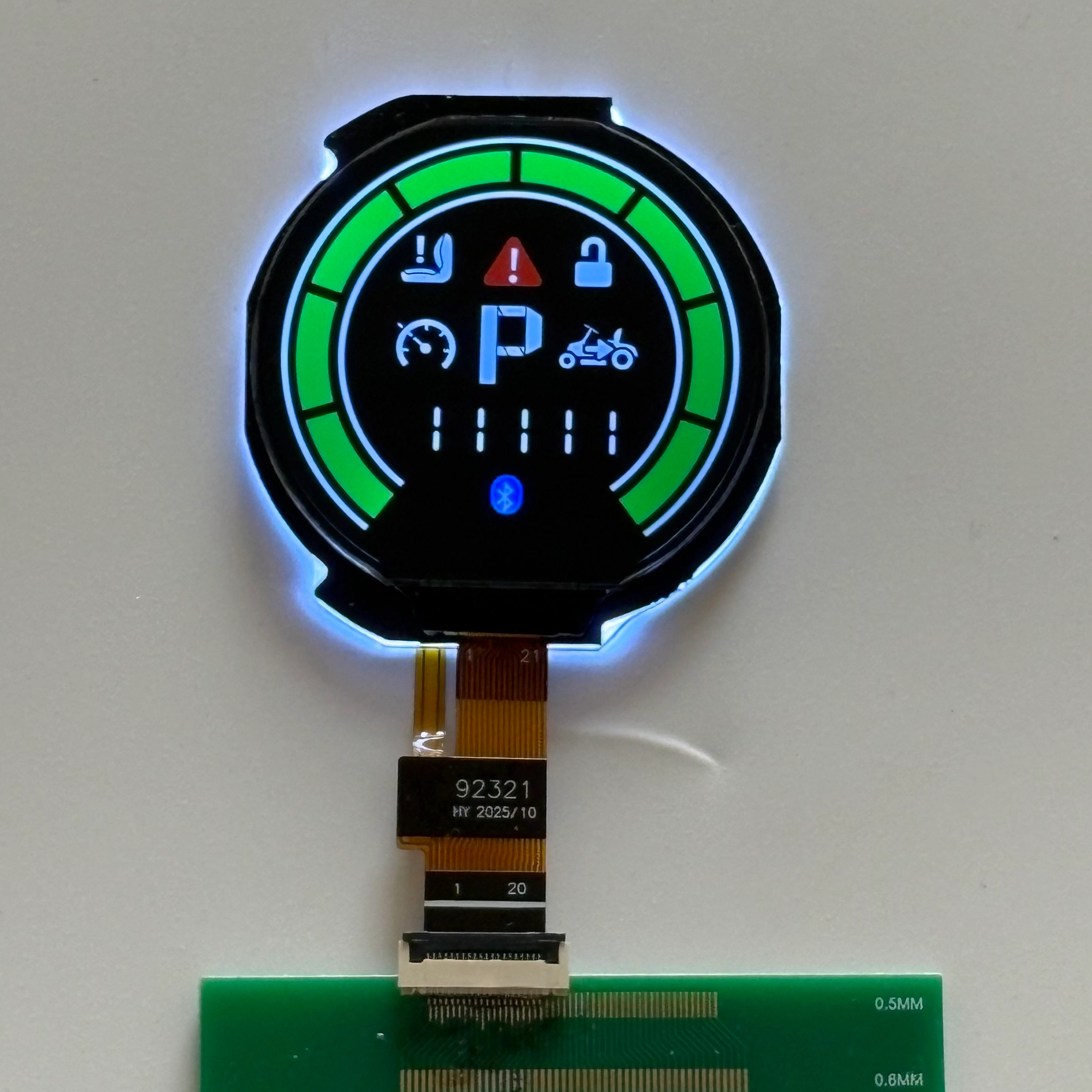
Engineers consistently praise the micro-amperage power draw of these devices. A static display often requires under 50μA/cm² to operate. This ultra-low current requirement makes them ideal for IoT edge devices. Portable meters and solar-dependent tools rely heavily on this efficiency. When a device must run for a decade on a single coin-cell battery, active matrix displays simply drain too much juice.
Proper drive mechanics play a crucial role in maintaining display life. You must use an Alternating Current (AC) signal to drive the liquid crystals. If you apply Direct Current (DC), the electrodes suffer from electro-corrosion. AC signals prevent this degradation entirely. The molecules continuously switch orientations. This careful electrical management prolongs the display life, frequently pushing it past 100,000 hours of continuous use.
Integrating these screens simplifies your PCB layout and boosts BOM efficiency. Many engineers use standard MCUs to drive the panel. You can rely on basic ICs or direct MCU drive based on specific duty cycles. Common configurations include static, 1/2 duty, or 1/4 duty multiplexing. Direct driving lowers overall power budgets. It also reduces the number of traces you need to route across your board.
Drive Method | Typical Application | Relative Power Consumption | Contrast Quality |
|---|---|---|---|
Static (1/1 Duty) | Basic numeric meters | Ultra-Low (<50μA) | Highest (Sharpest edges) |
Multiplex (1/2 Duty) | Thermostats, simple IoT | Very Low | High |
Multiplex (1/4 Duty) | Complex alphanumeric panels | Low | Moderate (Requires precise voltage) |
You must match the panel chemistry to your specific operational goals. Different twists of the liquid crystal molecules yield vastly different optical results. Choosing correctly balances cost, contrast, and viewing angles.
TN (Twisted Nematic): This serves as the baseline for cost-effectiveness. It offers a basic 90-degree twist. It works perfectly for basic digital clocks or simple numeric readouts where users look straight at the screen.
STN / FSTN: These offer higher twist angles (up to 270 degrees). They provide wider viewing cones. FSTN adds a specialized film compensation layer. This layer delivers sharper black-and-white contrast instead of the typical yellow-green background.
VA (Vertical Alignment): This premium option offers extremely high contrast. It provides a true black background with brilliant illuminated segments. You gain wide viewing angles up to 178°. However, you must carefully manage thermals. Response times can dip sharply in extreme cold environments.
Technology | Cost Tier | Viewing Angle | Best Use Case |
|---|---|---|---|
TN | Budget | Standard | Basic utility meters, entry-level tools |
STN | Moderate | Wide | Industrial panels, portable diagnostics |
FSTN | Mid-High | Wide | High-end medical devices, premium tools |
VA | Premium | Ultra-Wide | Automotive dashboards, dark-room equipment |
Engineers enjoy immense freedom when designing the physical layout. You can specify custom glass shapes to fit unique product housings. Precise segment mapping allows you to blend standard alphanumeric digits right next to proprietary system icons. You can even implement low-cost color segmentation. Factories achieve this using precise silk-print color filters directly on the rear glass. This makes critical warning icons glow bright red while standard text remains black.
Connection types also adapt to your specific mechanical requirements. Metal Pin connectors allow for rigid, permanent soldering directly to the PCB. They suit environments needing firm structural mounting. Alternatively, Rubber (Zebra) elastomeric connectors offer high-shock resistance. A Zebra connector sits compressed between the glass and the PCB. It absorbs heavy impacts seamlessly. This flexibility prevents the glass from shattering under intense mechanical resonance.
Even the most rugged technology fails if implemented incorrectly. Design engineers frequently encounter a few specific pitfalls during their first integration projects. By recognizing these risks early, you ensure a smooth product launch.
Viewing Angle Misalignment: You must clearly define the primary viewing axis during the design phase. Screens optimize for either a 6 o'clock (looking down) or 12 o'clock (looking up) viewing direction. Failing to match this to your final product housing leads to inverted contrast. The screen will look completely washed out to the end user.
Vibration Failures: Heavy tractors, mining drills, and factory floor equipment vibrate constantly. Skipping Optical Bonding in these environments invites disaster. High mechanical resonance will fracture standard air-gap screens. Bonding adhesives secure the layers together, creating a solid, shatter-resistant block.
Underestimating Environmental Variables: Never select a standard consumer-grade fluid or polarizer for an outdoor application. Sun exposure causes severe UV degradation over time. Standard polarizers will turn brown and crack. Always specify UV-resistant industrial polarizers for equipment stored outside.
Your supply chain partner determines the ultimate success of your product lifecycle. You must look for a reliable Segment LCD manufacturer that strictly utilizes in-house cleanrooms. Dust particles ruin cell gaps. Automated cell gap control prevents uneven fluid distribution and protects against visual contamination. Avoid small assembly shops that outsource their bonding processes.
Robust Quality Assurance guarantees long-term performance. You should always insist on standardized High-Temperature Operating Life (HTOL) testing. Ask the factory about their glass cleaning processes. A top-tier facility uses secondary and tertiary chemical washes. These extra steps completely eliminate the risk of electro-corrosion on the microscopic ITO traces over time.
Industrial devices typically require a 10 to 15-year lifespan. This demands long-term supply chain security. Evaluate the ability of the manufacturer to provide predictive maintenance data. Ask if they can reverse-engineer obsolete panels from previous suppliers. A true manufacturing partner guarantees parts availability for a decade. They protect you from sudden factory shutdowns or unexpected end-of-life notices.
Segment screens remain virtually irreplaceable within the rigorous industrial sector. They elegantly solve the most critical engineering constraints you face daily. They overcome severe power limitations, endure unpredictable environmental volatility, and alleviate intense budget pressure. By stripping away unnecessary graphical overhead, they deliver unbreakable reliability.
We encourage buyers to finalize their core specifications early in the design cycle. Define your optimal viewing angle, establish your extreme temperature range, and select your preferred drive method. Once you map out these parameters, consult with a specialized display engineering team. Request a custom drawing or order an engineering sample today to secure your product lifecycle.
A: Yes, reflective and transflective models rely entirely or partially on ambient light, drastically reducing power consumption.
A: Tooling costs are exceptionally low compared to custom TFTs, making custom icons and layouts highly accessible even for mid-volume industrial runs.
A: Driving liquid crystals with Direct Current (DC) causes irreversible electrochemical degradation. Alternating Current (AC) ensures the liquid crystal molecules continuously switch, maintaining the panel's 100k+ hour lifespan.


