
English 
Views: 0 Author: Site Editor Publish Time: 2026-09-28 Origin: Site


Designing modern smart devices forces engineers to make a critical choice. Display shape dictates product aesthetics, PCB layout, UI design architecture, and overall Bill of Materials (BOM) cost. Hardware engineers face intense pressure. You must build visually stunning products while maintaining strict budget controls. Sticking to standard rectangular screens is straightforward. It offers proven integration but can sometimes lack premium aesthetic appeal. Conversely, circular designs look highly sophisticated. However, they introduce complex software masking and physical hardware routing challenges. Balancing visual impact and engineering constraints requires careful analysis. This article provides hardware engineers and product managers with an objective, evidence-based framework. We will deeply explore the technical trade-offs between circular and rectangular display architectures. You will learn how to align display geometry with your specific user interface requirements. Our goal is to help you confidently choose the perfect display shape for your next-generation smart device projects.
UI/UX Adaptation: Square displays allow for standard software grid layouts, while round displays require custom UI masking and radial design architecture.
Hardware Efficiency: Square TFT LCDs offer higher active-area utilization and lower manufacturing costs due to standard glass-cutting yields.
Market Positioning: A round TFT LCD implies a premium, specialized aesthetic, making it the de facto standard for modern wearables and high-end smart dials.
Sourcing Reality: Choosing a custom display shape significantly impacts initial NRE (Non-Recurring Engineering) costs and minimum order quantities (MOQs).
Display geometry forms the foundation of your industrial design (ID). It dictates how users perceive and interact with your product. A screen acts as the primary focal point of any smart device. Its physical shape sets immediate user expectations. Rectangular geometry signals information density. It tells users they can read text, view charts, or scroll through lists. Circular geometry signals centralized focus. It directs user attention to a single, critical metric.
Early smartwatches originally featured square screens. They closely resembled miniature smartphones strapped to the wrist. Consumers heavily resisted this bulky aesthetic. Consequently, the wearable TFT display market rapidly shifted toward circular panels. This crucial pivot allowed digital devices to mimic traditional analog horology. Consumers naturally expect watches to have circular faces. Circular screens blend advanced digital capabilities seamlessly into a universally accepted classic form factor.
Shape also drives intuitive behavior in building automation. A smart home LCD display utilizes physical geometry to cue specific physical interactions. Consider a modern smart thermostat. Many premium models utilize a circular screen surrounded by a rotary bezel. The round shape instinctively prompts users to turn or twist the device. Conversely, a rectangular wall panel signals users to swipe or tap. You can effectively guide user behavior simply by selecting the right display shape.
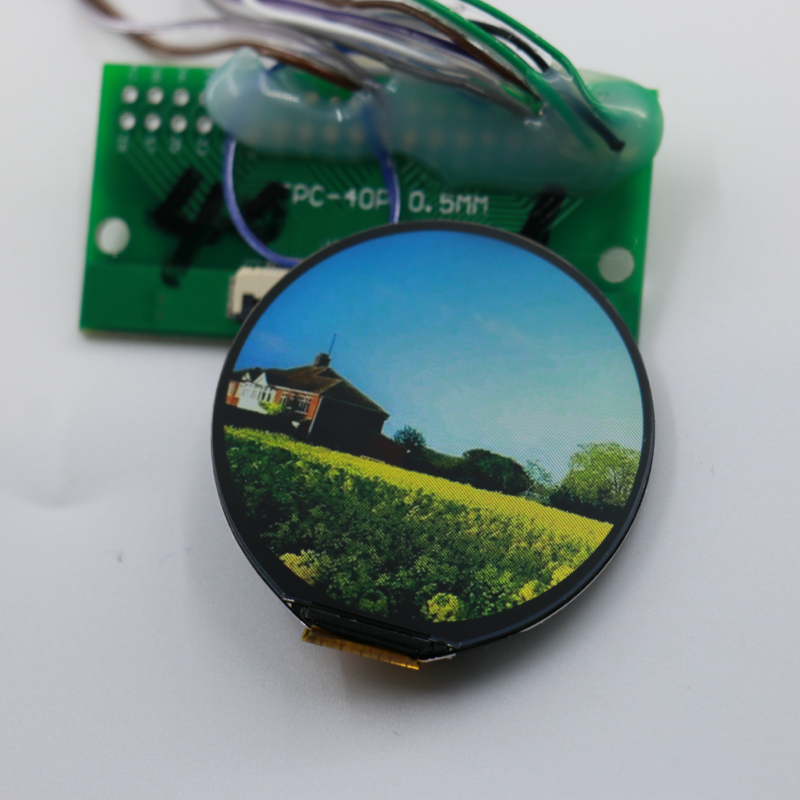
Circular displays offer immense aesthetic appeal. They look inherently premium and specialized. A round TFT LCD fits naturally inside cylindrical enclosures. They excel in rotary-knob applications and analog-style dial interfaces. You do not see harsh physical corners breaking the elegant circular illusion. This creates a deeply immersive user experience.
However, you must view these benefits through a skeptic’s lens. Manufacturing reality introduces strict constraints. Mother glass sheets are always rectangular. Cutting circles from rectangular glass leaves significant wasted corner material. These lower glass cutting yields inherently drive up the unit cost for a round LCD display. You pay for the glass you throw away.
Driver IC masking creates another massive engineering hurdle. Display driver integrated circuits (ICs) process data in strict rectangular matrices. A round screen still utilizes a rectangular memory map internally. Software engineers must write custom rendering code. They must accurately map standard rectangular pixel data into a circular active physical area.
Common Mistake: Failing to properly mask the "dead corners" in software can cause memory buffer overruns. It can also produce erratic visual artifacts along the display edges.
Despite these challenges, specific products justify the effort. The best-fit applications include premium smartwatches, luxury automotive gauge clusters, and high-end smart HVAC control dials.
Rectangular panels dominate the display industry for a reason. A square TFT LCD maximizes data density. It utilizes exactly 100% of its physical active display area. You can display long text blocks, complex charts, and nested menus without awkward cropping. Standard orthogonal glass cutting ensures exceptionally high manufacturing yields. This directly translates to a lower overall BOM cost.
Software simplicity provides a massive engineering advantage. Rectangular screens offer native compatibility with standard UI frameworks. Operating systems like Android, Embedded Linux, and common RTOS libraries are built for rectangles. Your development team avoids custom pixel masking entirely. Developers save countless hours of graphics rendering optimization.
Implementation realities do present minor aesthetic challenges. Square screens can sometimes feel generic. In specific wearable form factors, they look visually outdated if the bezel remains exposed. You must carefully design the surrounding enclosure to modernize the look.
Best Practices for Rectangular Integration:
Use black-mask printed cover glass to seamlessly hide the physical display bezels.
Implement a dark-mode UI theme to blend the active screen edge into the dark bezel.
Apply 2.5D curved cover glass to soften the harsh physical corners of the enclosure.
The best-fit applications span a wide range. They include industrial control panels, medical devices, IoT gateway hubs, and highly cost-sensitive consumer electronics.
Understanding cost versus volume is critical. Economy of scale changes the math. Off-the-shelf rectangular panels are heavily commoditized. Circular cutting processes command a distinct manufacturing premium. High-volume production helps offset circular tooling premiums. Low-volume projects heavily favor standard rectangular modules to preserve budget.
Visual performance dictates user satisfaction regardless of shape. Specifying an IPS TFT module is absolutely critical for both geometries. Older TN (Twisted Nematic) panels suffer from severe color inversion at off-axis viewing angles. Users look at smartwatches and wall-mounted thermostats from extreme and unpredictable angles. IPS technology eliminates these dead viewing zones entirely. It ensures crisp, accurate color reproduction from any angle.
PCB space and FPC routing require physical compromise. Circular housings leave awkward crescent-shaped internal cavities. Routing the Flexible Printed Circuit (FPC) inside a round enclosure requires tight bending radiuses. Rectangular housings align perfectly with standard rectangular mainboards. They offer efficient packing volume for batteries and backlight cables.
Evaluation Criteria | Square / Rectangular Display | Round / Circular Display |
|---|---|---|
Active Area Utilization | 100% efficiency. Ideal for dense data and text. | ~78% efficiency. Crops corner data completely. |
Glass Cutting Yield | High yield. Minimal mother glass waste. | Lower yield. Wastes corner glass material. |
Software Integration | Native RTOS/Android support. No masking. | Requires custom radial UI and corner masking. |
FPC Routing Space | Straightforward alignment with standard PCBs. | Tight internal radiuses. Tricky crescent spacing. |
Aesthetic Perception | Utilitarian, standard, information-focused. | Premium, specialized, analog-horology inspired. |
Your supply chain dictates project success. Evaluating vendor manufacturing maturity is crucial. Working with a custom TFT LCD supplier requires careful vetting. A capable vendor must demonstrate extensive experience with circular CNC glass shaping. They must reliably produce uniform edge profiles without inducing micro-cracks in the glass substrate.
Compliance and durability demand rigorous testing. Optical bonding significantly improves impact resistance and optical clarity. Applying LOCA (Liquid Optically Clear Adhesive) on round panels requires specialized curing fixtures to prevent edge pooling. Cover glass customization introduces further complexity. Manufacturing 2.5D or 3D curved glass is notably harder on round edges. Furthermore, sealing devices against water and dust requires precise engineering. Round shapes generally seal beautifully with standard radial O-rings. Rectangular screens often require custom-molded silicone gaskets to achieve high IP ratings.
Use this shortlisting logic to finalize your display strategy. This 3-step checklist helps determine if aesthetic value justifies increased engineering overhead:
Assess UI Data Requirements: Does your device need to display complex lists and graphs? If yes, default strictly to a rectangular screen.
Evaluate BOM Constraints: Does your unit cost strictly cap at a low threshold? If yes, leverage the high yield of standard square panels.
Determine Interaction Goals: Does the device rely on a single, centralized metric or a physical rotary bezel? If yes, invest the NRE to develop a premium circular interface.
Selecting the right display shape profoundly impacts your product development lifecycle. The geometric evaluation framework is clear. You should default to square panels for data-heavy, cost-sensitive, or rapid-prototyping projects. They offer unbeatable yield efficiency and seamless software integration. Conversely, you should invest in round panels for premium, design-first, single-interaction interfaces. They deliver an unmatched analog aesthetic that modern consumers crave in high-end wearables and smart dials.
Take proactive action today to de-risk your hardware pipeline. Prompt your decision-makers to request a detailed technical consultation. Order standard samples of both shapes to test FPC routing physically. Evaluate custom tooling tolerances carefully alongside your core engineering team.
A: No. Display driver ICs inherently handle standard rectangular data matrices. Round displays utilize the exact same standard ICs. However, they require your software or display controller to actively "blank out" the inactive corner pixels. The memory map remains rectangular, even though the physical glass is cut into a circle.
A: Yes. IPS (In-Plane Switching) refers to the internal liquid crystal alignment technology. It operates entirely independently of the outer physical glass cutting shape. You can easily source high-quality IPS modules in both standard square and custom round configurations.
A: Custom round displays carry significantly higher Non-Recurring Engineering (NRE) costs. A standard square panel often avoids tooling fees entirely. A non-standard round shape typically requires custom CNC glass cutting tools, custom backlight light guide plates (LGP), and custom physical bezel tooling.
A: Yes. You can apply a "software masking" workaround. This involves mounting a standard square display behind a round physical bezel opening. While this saves glass-cutting costs, it wastes significant active display space, increases battery drain, and often causes visible backlight bleed in the hidden corners.


